

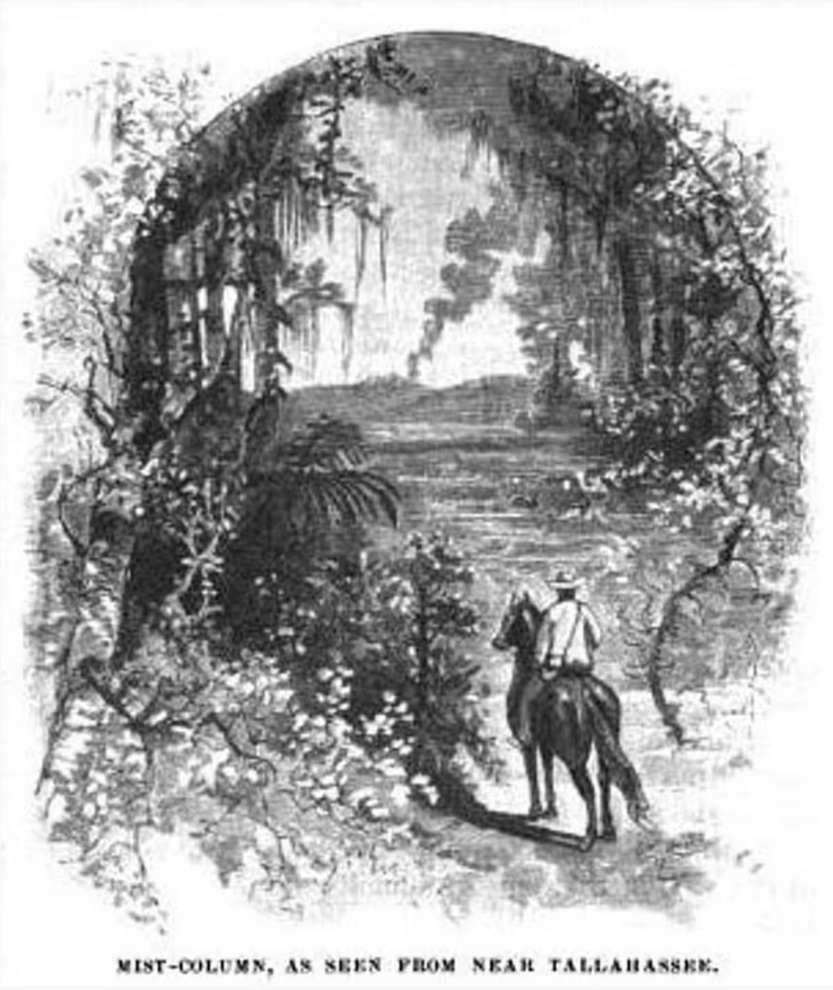
Climb to the top of the Florida Capitol in Tallahassee in the mid-1800s, look southeast toward the Gulf, and you'd have seen something odd: a thin, dark column of smoke rising above the horizon. It was there every day. Fishermen working Apalachee Bay used it as a landmark. Settlers clearing land in the pine flatwoods got used to it. During the day it looked like a storm cloud that never moved. At night, travelers said they could see a faint orange glow along the tree line.
People called it the Wakulla Volcano.
Where the smoke came from
Reports of the smoke go back through Florida's territorial years and into the second Spanish colonial period. It came from somewhere in the swamps along the line between southern Wakulla and Jefferson counties, around the Gum Swamp. Today that's protected land near the St. Marks National Wildlife Refuge.
Nobody could just walk out and look. The swamp was cypress knees, sawgrass, black muck and alligators, with no clear way through. With no facts to go on, people filled the gap with stories.
During the Civil War, a popular theory held that the smoke was a signal fire. Depending on who was telling it, the fire belonged to Confederate deserters, people who had escaped slavery, or Union sympathizers hiding in the marsh and signaling the blockade ships offshore. Others blamed moonshiners or pirates holed up in the coastal hammocks. Some locals just joked that it was the Devil stirring his tar kiln, or the Old Man of the Swamp puffing on an enormous pipe.
The smoke also turned up in literature. In 1922, Tallahassee writer Reinette Long Hunt published Osola, a long poem about an Indigenous boy who keeps a fire burning so his father can find his way home. It reached a national audience in March 1882, when Barton Jones wrote about it for Lippincott's Magazine and called it "the Wakulla Volcano." The name stuck.
The expeditions
Of course people tried to reach it. In the 1870s, a New York newspaper correspondent hired three local guides and headed into the swamp. They hacked their way through for three days. Then one guide climbed a tall cypress to get a fix on the smoke and fell. The group turned back. On the way back to Tallahassee the reporter came down with swamp fever, and he died not long after.
In 1891, Tallahassee resident J.H. Staley led more trips into the swamp. Charles Ledyard Norton, author of A Handbook of Florida, came along on one of them. They spent weeks dealing with mosquitoes, snakes and mud that seemed to have no bottom. They found no lava.
The search didn't stop there. In the 1920s, Judge A.L. Porter and James N. Kirkland said they'd found strange charred limestone pits deep in the woods. Bill Wyatt, who grew up in Tallahassee, remembered a long weekend in the 1930s spent bumping into the brush in a Model T looking for the spot.
The night it went out
The smoke didn't fade away over time. It stopped all at once. On the evening of August 31, 1886, a magnitude 7.0 earthquake struck near Charleston, South Carolina. The shaking reached North Florida. Water sloshed in wells, church bells rang in St. Augustine, and Lake Jackson in Leon County reportedly drained into its sinkholes.
After that night, nobody saw smoke over the Wakulla swamp again.
Comments
Join the conversation
Sign in or create an account to share your thoughts