
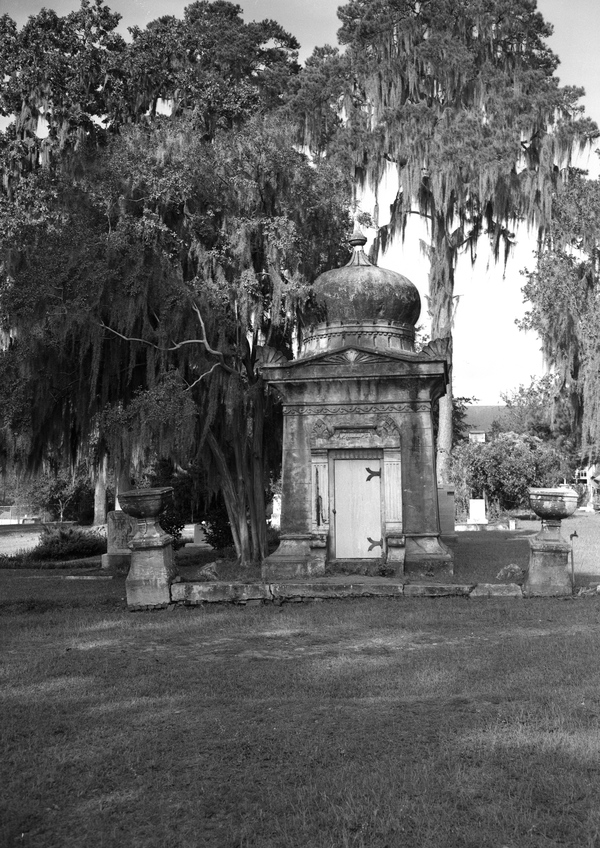
Oakland Cemetery sits under a heavy cover of live oaks and Spanish moss near Brevard and North Bronough streets. It's Tallahassee's oldest public cemetery. Among its 19th-century headstones and sunken family plots is one of the strangest things in the capital: a heavy stone vault with an onion dome on top, the kind you'd expect to see on a Russian church.
People call it the Phillips Mausoleum. Calvin Clarendon Phillips, an architect from New York, designed it, moved into it while he was still alive, and was buried in it. He left behind very little and left behind a trail of unanswered questions.
The man who measured time
Most of what gets said about Phillips is closer to folklore than fact, mainly because he lived as a hermit. He was born in New York around 1832 and came to Florida late in the 1800s. Local accounts and family stories describe him as a skilled architect, and they link his early career to exhibition work in Pennsylvania and at the 1878 Paris Exposition. Medals honoring his work were reportedly placed in the tomb with him.
In Tallahassee he was known for two things: his buildings and his solitude. He lived in what's now the All Saints neighborhood, in an odd house with a tall wooden clock tower. In a 1985 essay called "The Tale of a Man Obsessed with Time," former Governor LeRoy Collins wrote:
"No one recalls ever seeing Phillips in a bank, post office, church, school or other place where groups of people normally would gather."
Genealogists have gone through census rolls and vital records looking for him and keep coming up empty. Some suspect "Calvin Phillips" wasn't his real name, and that he took it when he walked away from whatever life he had before.
Building his last home
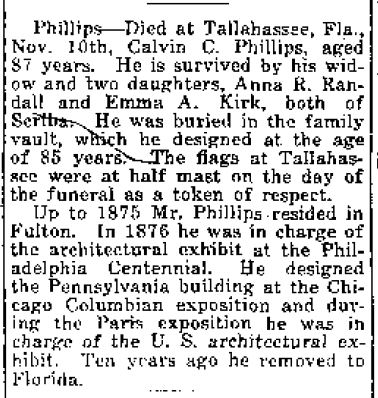
In 1919, at about 87, Phillips started work on his own tomb. He picked a corner lot in Oakland Cemetery and oversaw construction of a heavy stone mausoleum with classical pilasters, decorative urns, and the onion dome on the roof.
He didn't stop at supervising. Cemetery workers and people walking by saw the old man sitting inside the unfinished tomb for whole days, and often napping there, where it was cool and shaded. He had a cherry casket built and placed inside. The vault had room for four crypts. Nobody else ever joined him.
In November 1919 he seemed to know he was close to the end. He gave the keys to his lawyer and friend, State Senator William C. Hodges, who later owned Goodwood Plantation and is buried a few yards away. Phillips died soon after, at 87. There was no public funeral. The door was locked, and he stayed there, undisturbed, for more than 80 years.
The missing skull
For decades the tomb was just a curiosity for people cutting through the cemetery. The clock tower house in All Saints fell apart over the years, and the last of it was gone by the mid-1980s.
In April 2000, someone broke into the mausoleum. They forced the door, opened the cherry casket, cut off Phillips' head, and left with the skull.
Tallahassee police investigated but had almost nothing to work with. More than 25 years later the skull hasn't turned up, and the case is still open. It's a big part of why the tomb comes up every Halloween.
The city locks the cemetery gates at night now. During the day you can still find the weathered stone marked simply "Phillips" under the moss. A man who apparently didn't want to be known designed his own grave, moved into it early, and took his real story with him.
Comments
Join the conversation
Sign in or create an account to share your thoughts